





Sustainability Materiality Analysis


Sustainability Materiality Analysis
To ensure effective sustainability management, alignment with broader governance and economic, social, and environmental developments, and responsiveness to stakeholder expectations, Osotspa conducts a comprehensive materiality assessment every three years and reviews the relevance of material topics annually. The assessment covers sustainability matters across all ESG dimensions.
In 2025, the Company conducted a materiality assessment to identify its material sustainability topics in accordance with the Global Reporting Initiative (GRI) Standards 2021 and the AA1000 Stakeholder Engagement Standard. The assessment was guided by the principle of double materiality, considering both the impacts of the Company’s activities on society and the environment, and the potential effects of ESG-related matters on the Company’s financial performance and long-term value creation. The assessment process comprised the following steps:
Assessment and Review of Organizational Context and Current State
- Assessed the Company’s business context, key risks and opportunities, business partner relationships, and relevant sustainability and stakeholder considerations to identify an initial list of sustainability topics.
- Reviewed the Company’s performance, industry trends, relevant sustainability reporting standards and frameworks, including GRI Standards, SASB Standards, CSRD, TCFD, DJSI, and FTSE Russell ESG Ratings, together with peer benchmarking against companies in the same industry.
- Reviewed the Company’s value chain and risk assessment framework to better understand sustainability-related impacts, risks, and opportunities across the business.
Stakeholder Engagement
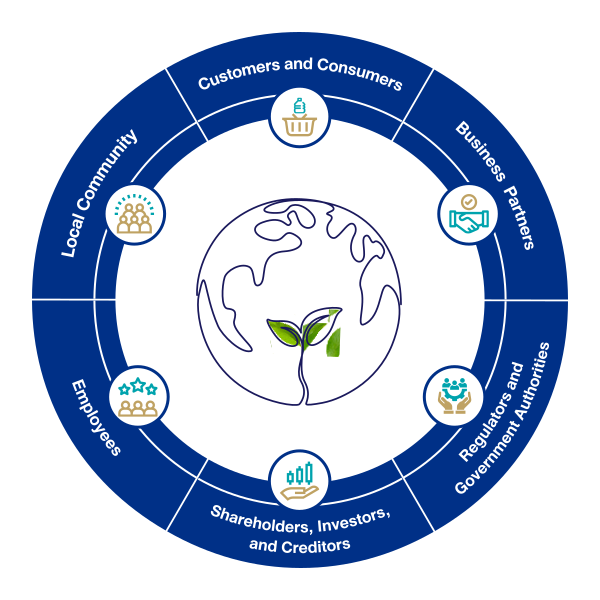
- Engaged with all six stakeholder groups to gain insights into their concerns, expectations, and perspectives, while assessing both the Company’s impact on society and the environment and the potential effects of ESG-related matters on its financial performance.
- A total of 372 stakeholders across six stakeholder groups participated in the assessment through in-depth interviews and stakeholder surveys.
Identification, Assessment, and Prioritization of Material Topics
- Developed assessment criteria to evaluate the materiality of sustainability topics based on stakeholder input and the significance of actual and potential impacts.
- Assessed and prioritized sustainability topics by considering stakeholder perspectives together with the Company’s sustainability-related impacts, risks, and opportunities. The material topics are classified into three categories:
Critical
Focus
Foundational
Validation and Approval of Material Topics
External Expert Review & Validation
Engaged with external experts to review the materiality assessment process and results, provide feedback, and validate the Company’s material sustainability topics.
Governance Review & Board Approval
Presented the materiality assessment results and prioritized material sustainability topics to the Sustainability Working Team and the Nomination, Remuneration, Corporate Governance and Sustainability Committee for review. The results were subsequently reviewed and approved by the Board of Directors, which provides final approval of the Company’s material sustainability topics.
Independent Assurance
Assured by Thaipat Institute. The assurance scope explicitly covers the Materiality Assessment requirements under ESRS and was conducted in accordance with AA1000AS v3, Type 1, at a Moderate level of assurance.
The results of the 2025 sustainability materiality assessment and analysis were consistent with the topics identified in the previous comprehensive assessment, comprising a total of 14 material sustainability topics. The results of the materiality assessment are integrated into the Company’s Enterprise Risk Management (ERM) process, whereby the identified material sustainability topics are reviewed against the Company’s enterprise risks and opportunities, and relevant sustainability-related risks and opportunities are incorporated into the Company’s risk assessment, mitigation, and monitoring processes. The Company will also integrate these material sustainability topics into the OSP Sustainability Framework from 2026 onwards. The topics are classified into two groups as follows:
Highly Material Topics
Material Topics
Top Materiality Issue
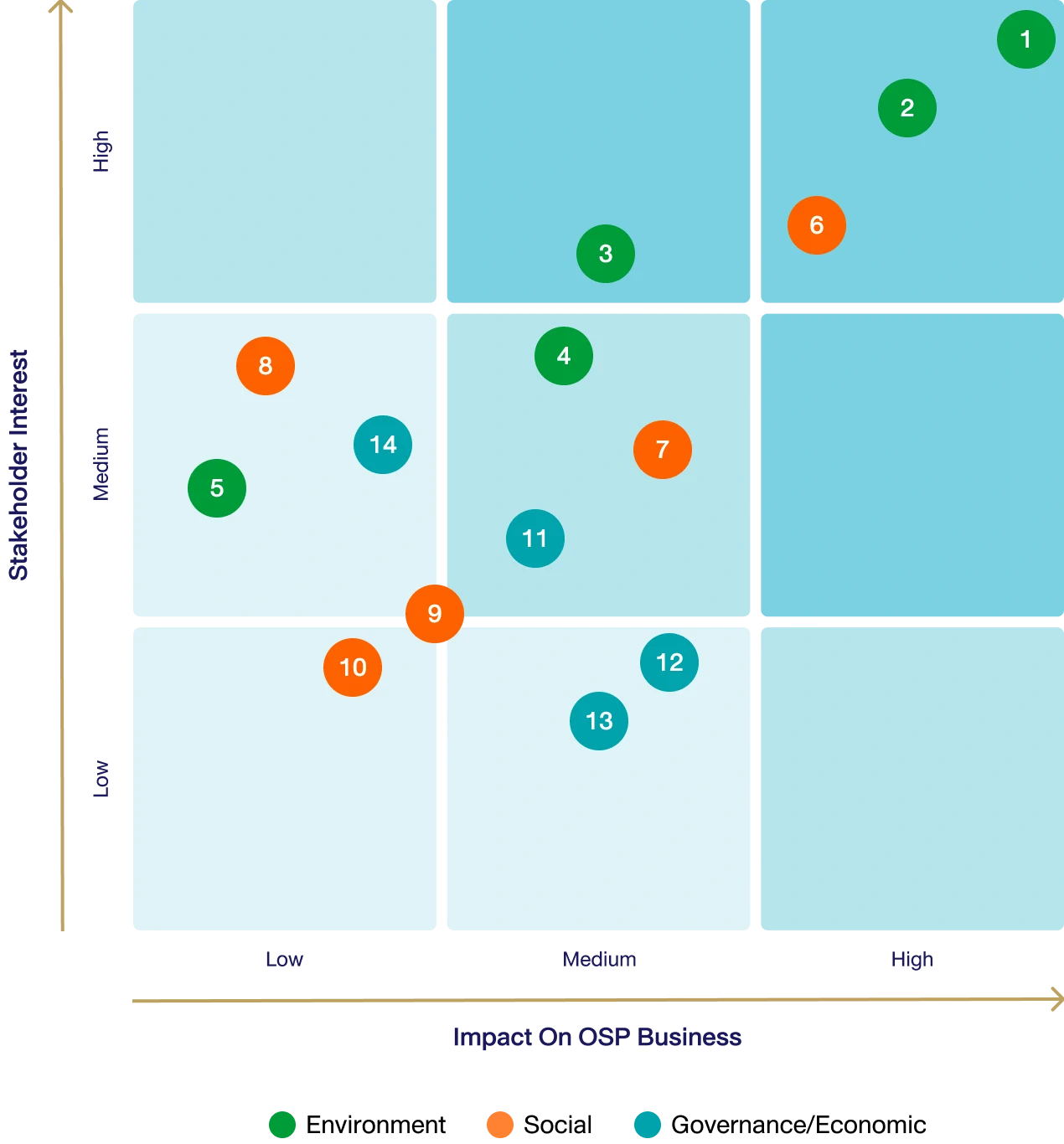
Highly Material Topics
-
1Energy Management & Climate Change Mitigation
-
2Water Resource Management
-
6Human Capital & Labor Practices
-
3Sustainable Packaging
-
4Waste Management
-
7Consumer Health & Well-being
-
11Sustainable Supply Chain
Material Topics
-
5Biodiversity
-
8Responsible Communication & Product Labelling
-
9Corporate Citizenship & Philanthropy
-
10Human Rights
-
12Corporate Governance & Business Ethics
-
13Product Quality & Safety
-
14Product Innovation