





Enterprise Risk Management


Enterprise Risk Management
Osotspa recognizes the importance of effectively responding to rapid changes in the business environment arising from both internal and external factors. To ensure efficient and transparent operations and the achievement of its objectives, the Company places importance on risk management at all levels and has established a risk management framework aligned with the principles of Good Corporate Governance.
The Company’s risk management approach aims to mitigate the impacts of risks while identifying and enhancing business opportunities, supporting the achievement of the Company’s objectives in alignment with its strategies, operational plans, and applicable laws and regulations, while appropriately considering the interests of its stakeholders. The Company manages risks in accordance with the internationally recognized COSO Enterprise Risk Management (COSO ERM) Framework.
The key principles of Osotspa’s Risk Management Policy are as follows:


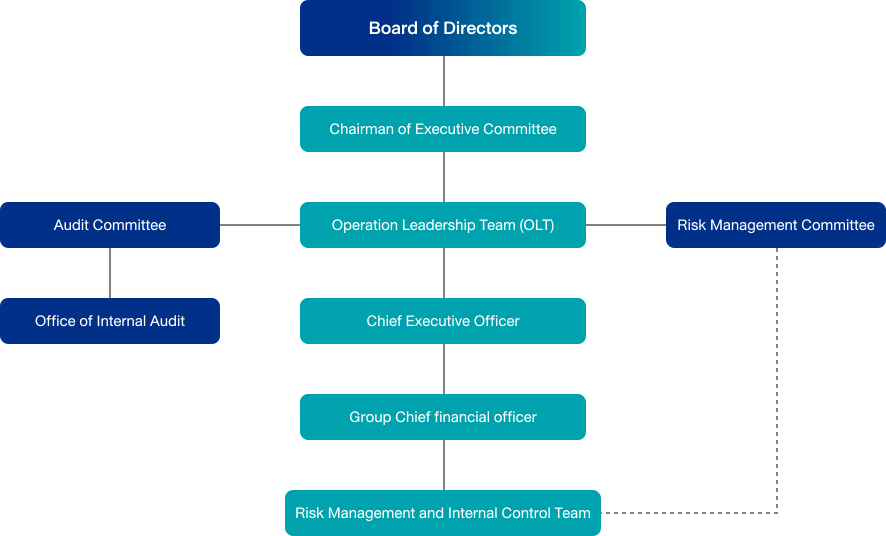
Osotspa has established a risk management structure as illustrated above. The Board of Directors serves as the highest governing body overseeing enterprise-wide risk management and has appointed the Risk Management Committee to provide guidance and review the Company’s enterprise risk management practices, as well as to establish a risk management framework aligned with the Company’s objectives and the evolving business environment.
The Osotspa Leadership Team (OLT) supports the implementation of the risk management process and continuously monitors progress. In addition, the Risk Management and Internal Control Team works with relevant functions to identify and assess risks, develop risk mitigation plans, monitor risk management performance, and report the results quarterly to senior management, the Risk Management Committee, and the Board of Directors.

Risk Management
Osotspa manages risks at two key levels: Enterprise Risk Management (ERM) and Functional Risk Management (FRM) at the business unit and functional levels. These two approaches work together to manage risks across all levels of the Company’s operations and enhance the Company’s preparedness for future challenges. The risk assessment covers eight risk categories, as follows:
- Strategic Risk
- Financial Risk
- Operational Risk
- Legal, Compliance and Fraud Risk
- Information Technology (IT) Risk
- Sustainability Risk
- Reputational Risk
- Emerging Risk

Business Continuity Management
Osotspa has implemented Business Continuity Management (BCM) to strengthen its risk management strategy, with a focus on preparedness for crises and disruptive events that could affect the Company’s ability to maintain business operations. The Company develops recovery plans and effective response measures to enable timely and appropriate responses to crises or unexpected events and support the continuity and recovery of critical business operations.
To strengthen its overall risk management approach and enhance preparedness for various types of risks, the Company integrates Enterprise Risk Management (ERM), Functional Risk Management (FRM), and Business Continuity Management (BCM). The integration of these three systems enhances the Company’s resilience and ability to respond effectively to future challenges and crises, supporting business continuity and long-term sustainability.

Risk Management Culture
Osotspa recognizes the importance of fostering a strong risk management culture among employees across the organization. The Company has established a Risk Management Policy to ensure a consistent and aligned approach to managing all types of risks and to enable risks to be effectively controlled and managed. The Company also promotes a culture of risk management and internal control, with the aim of enhancing employee awareness and encouraging the application of risk management practices and actions to mitigate risks across the organization on a sustainable basis. Key strategies include:
- Establish senior and middle management as role models for risk-based management. The Company expects senior and middle management to integrate risk management into their work and provide guidance to their teams. At least once a year, the Company conducts workshops for senior and middle management to enhance their knowledge and understanding of current developments that may present both risks and opportunities to the Company. Through these workshops, management participates in enterprise-wide risk management by gaining insights into emerging trends that may pose risks to the business, jointly identifying key risks, developing risk mitigation plans, and communicating identified risks and mitigation measures to their respective functions.
- Integrate risk and opportunity assessment into the O-IPM process. O-IPM is Osotspa’s internal management process designed to support effective decision-making in bringing goods, products, and services to market and serves as the basis for the Stage-Gate Process used to manage the innovation process. At each stage, the Gatekeepers monitor project plans, assess risks and opportunities, and determine whether projects should proceed, be postponed, or be terminated.
- Provide risk management training to functions across the organization. The training is designed to enable employees to apply risk assessment tools in their day-to-day operations. In 2025, the Company conducted training sessions and workshops with various business units, including the Manufacturing Business. Risk management activities are reported to supervisors to support ongoing monitoring. The Company also has a long-term plan to extend risk management training and initiatives across all business groups within Osotspa.
- Provide regular risk management communication and training to employees across the organization to continuously strengthen risk awareness and understanding.
Osotspa is committed to fostering a strong risk management and internal control culture, with senior and middle management serving as role models. The Company aims to enhance employee awareness and embed risk management practices into day-to-day operations on a sustainable basis. To support this approach, the Company has clearly defined the roles and responsibilities of relevant functions in risk management and adopted the Three Lines Model of The Institute of Internal Auditors (IIA) as its operational framework, as follows:
First Line

Second Line

Third Line

Risk Management Process and Examples of Key Risk Assessments
Osotspa’s risk management process comprises the following steps:
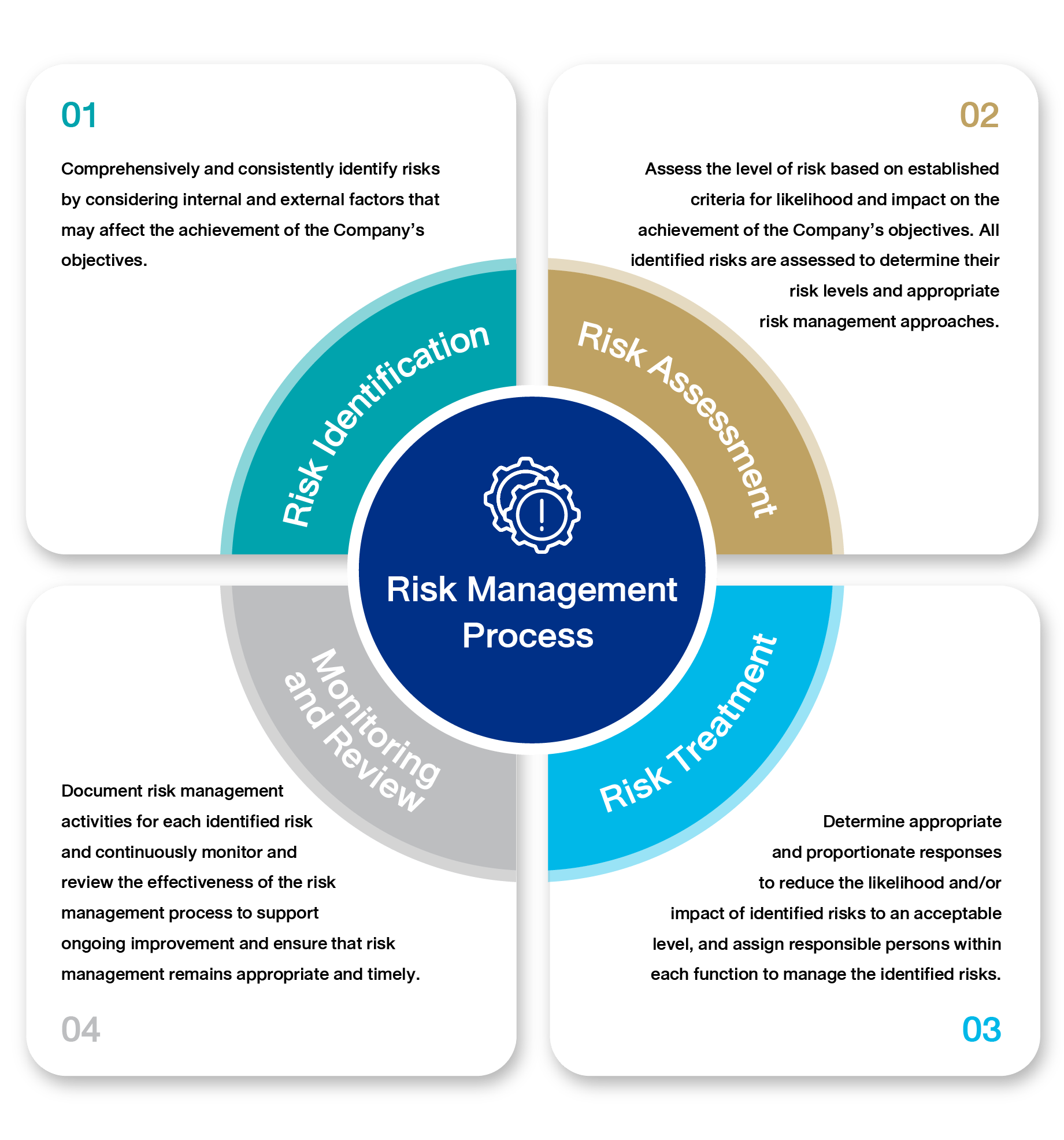
Osotspa has established Risk Assessment Criteria to assess and review key risks based on their likelihood of occurrence (Likelihood) and impacts on the business and stakeholders (Impact). The impact assessment covers financial performance, corporate reputation and image, operations, supply chain, non-compliance with laws, regulations and requirements, human resources, and occupational safety, health and working environment. Risk impacts are classified into four levels. Further details are available in the Company’s Risk Management Policy.
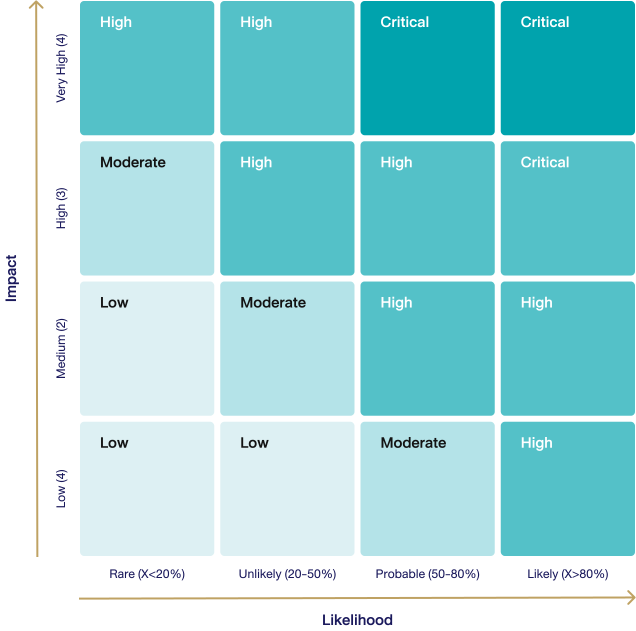
Examples of Key Risk Assessments
| Risk | Potential Impacts | Risk Management Measures | Risk Level |
|---|---|---|---|
| 1. Domestic and international investment and business operations exposed to economic uncertainty, exchange rate volatility, and disasters or unexpected events that may disrupt business operations |
|
The Company seeks to expand its investments and explore partnerships to reach new customer segments in other markets and strengthen its business capabilities, while implementing measures to mitigate financial and business continuity risks. | Very High |
| 2. Succession planning and employee capability development to support future growth |
|
The Company places significant emphasis on addressing future challenges and has established initiatives, including strengthening organizational continuity and resilience, attracting talented employees, providing career development opportunities through employee development programs and job rotation, establishing a comprehensive knowledge base and developing employee capabilities across various skill areas, communicating the ACT Culture to employees at all levels, strengthening the Company’s employer brand to attract talent, and continuously fostering a hybrid work culture. | High |
Risk Factors and 2025 Performance
In 2025, Osotspa reviewed the risk factors identified in the previous year, identified new and emerging risks, and developed corresponding risk management plans, as detailed below:
New investments and domestic and international business operations arising from economic uncertainty, exchange rate volatility, and disasters or unexpected events affecting business operations
- Domestic and international investments undertaken to expand the business may not achieve strategic objectives amid economic uncertainty.
- Overseas business operations are exposed to various risks, including political stability and foreign exchange rate volatility.
- Events that may disrupt or prevent normal business operations could affect the Company’s ability to manufacture or deliver products and may result in financial and reputational damage, such as earthquakes, fires, floods, transportation accidents, or machinery breakdowns.
Impacts
- Unintentional violations of or non-compliance with regulations in individual countries, or operational gaps that may result in non-compliance with applicable local laws or regulations.
- Supply chain disruptions arising from political unrest and instability or changes in government policies may affect business operations, resulting in an inability to procure raw materials or products or deliver products in a timely manner, potentially leading to shortages, delays, and increased operating costs.
- Volatility in revenue and/or financial costs may affect the Company’s revenue and the preparation of its consolidated financial statements.
- Damage caused by disasters may disrupt business operations, including utilities and distribution activities across different locations.
- Increased costs associated with restoring normal operations.
- Damage to the Company’s reputation and corporate image.
Risk Management Plans
The Company considers opportunities to expand its investments or engage with business partners to reach new customer segments in other markets and enhance its business capabilities. The Company also implements measures to manage financial risks and risks of business disruption, as follows:
Domestic and International Investments
- Establish guidelines for conducting feasibility analyses, market research, and investment return assessments, taking into account key risks and mitigation plans, resource planning, and the development of employees’ project management capabilities.
- Analyze internal and external factors to develop alternative plans and conduct business impact assessments to enhance operational effectiveness under uncertain conditions.
Overseas Business Operations
- Maintain preparedness and closely monitor developments to establish appropriate management plans and report relevant matters to management and working teams, enabling timely responses to issues.
- Closely oversee and monitor the operational and financial performance of investments. Where performance does not meet established targets, the Company conducts enhanced monitoring and escalates the matter to senior management for consideration and determination of appropriate management actions.
- Adjust operational strategies as appropriate, including adapting operating systems to local contexts, to manage political instability and other uncertainties.
Foreign Exchange Volatility
- Establish approaches for managing foreign currency-denominated revenues and expenses and use forward foreign exchange contracts to manage foreign exchange risk.
- Monitor, compile, and analyze foreign exchange rate information from reliable sources to assess and anticipate potential impacts on foreign currency-denominated revenues and expenses, enabling effective and timely management planning.
Business Disruption from Unexpected Events
- Conduct risk assessments of events that may affect the Company and perform Business Impact Analysis (BIA) to support the continuity of critical business processes.
- Develop Business Continuity Plans (BCPs) to enable immediate response when required, together with recovery plans to support an effective return to normal operations.
- Develop plans for managing necessary resources to address risks arising from various events and ensure preparedness for timely incident management.
- Establish exercise and testing plans to strengthen organizational preparedness, and regularly monitor and review the plans to ensure that they remain up to date.
- Maintain insurance coverage for potential losses arising from various events, covering all Company assets, to mitigate the financial impact of losses that may result from unforeseen events.
Business Competition and Market Share
Intensifying business competition arising from an increasing number of existing and new competitors, as well as competition in pricing, innovation, product quality, distribution channels, and aggressive marketing activities, may result in the Company losing competitiveness and market share.
Impacts
- Decline in the Company’s revenue, profit, and market share.
- Increased costs associated with maintaining competitiveness.
- Challenges in maintaining market leadership and brand loyalty.
Risk Management Plans
Given the highly competitive environment in the beverage and personal care industries, business competition and market share represent significant risks to the Company. The Company implements the following measures to manage these risks:
- Continuously develop marketing strategies, analyze costs, market conditions, and competitors, manage distribution channels and collaboration with business partners and analyze existing customer segments and future demand trends.
- Develop and implement ongoing marketing and promotional plans tailored to different customer segments and measure their effectiveness to identify areas for improvement and make appropriate adjustments.
- Develop new products and innovations to broaden consumer choices and product variety, while building awareness of new brands, strengthening existing brands, and continuously engaging with target customer groups.
- Regularly monitor and refine strategies to enhance operational effectiveness.
Commodity Price Volatility Risk
Volatility in the prices of raw materials and commodities, such as sugar, cullet, natural gas, and other key production inputs, may arise from changes in global supply and demand, government support and regulatory measures, import restrictions, taxes and customs tariffs, as well as broader economic conditions.
Impacts
- Higher raw material costs may increase overall supply chain costs. Price volatility may also increase management costs and adversely affect the Company’s revenue and operating profit.
Risk Management Plans
Volatility in raw material and packaging prices is a factor that may affect the Company’s overall costs. The Company has established plans and preparedness measures as follows:
- Monitor market information and government policies, including domestic market developments and global market prices, to support planning and preparedness for changing business conditions through market intelligence.
- Establish pricing structures by benchmarking prices across multiple suppliers within the same industry to ensure that procurement prices are aligned with prevailing market prices.
- Enter into long-term purchasing agreements with key suppliers, identify alternative suppliers, and maintain strong relationships with key suppliers. The Company also adopts flexible contractual arrangements to reduce uncertainty regarding procurement volumes.
Product Quality and Safety
Contamination of raw materials or finished products, or the entry of unsafe counterfeit products into the market.
Impacts
- Risks to consumer health and safety.
- Damage to the Company’s reputation and brands.
- Litigation that may adversely affect consumer confidence.
- Increased management costs arising from product recalls, legal and intellectual property matters, as well as potential revenue losses resulting from a decline in market share.
Risk Management Plans
The Company places the highest importance on product quality and safety, given the nature of its consumer products business. Rigorous quality controls are implemented throughout the production and distribution processes. The Company’s risk management measures include:
- Implement quality control, quality assurance, and total quality management throughout the value chain, from raw material suppliers to consumers, including change management and the establishment of structural quality indicators across relevant functions.
- Continuously implement and enhance quality strategies in accordance with high manufacturing standards, with a focus on the safety and integrity of production processes, while promoting a strong quality mindset and food safety culture.
- Maintain certification against international safety and quality standards, including FSSC 22000 Version 6, a food safety management system certification covering food manufacturing and incorporating food fraud prevention across the supply chain. The Company is also in the process of implementing ISO 45001 to enhance its occupational health and safety management system.
- Conduct comprehensive risk assessments in collaboration with relevant stakeholders for projects and changes to effectively manage potential risks and maintain product quality and safety in accordance with applicable standards.
- Provide the Osotspa Consumer Hotline to monitor consumer feedback and receive complaints and recommendations. A dedicated team, led by the responsible project lead, coordinates with relevant functions to ensure timely responses and resolution of issues.
- Raise consumer awareness of product quality and safety, including how to identify counterfeit products, by providing product information through various electronic communication channels and the Osotspa Consumer Hotline.
Succession Planning and Employee Capability Development for Future Growth
Human resources are a critical factor in business operations. Reliance on key personnel, shortages of skilled employees or limited workforce capabilities, as well as a lack of organizational agility, may hinder business success. This is particularly relevant to developing employee skills and capabilities to enhance organizational competitiveness and foster a High-Performance Culture.
Impacts
- An inability to develop employee capabilities may adversely affect the Company’s competitiveness and long-term organizational growth.
Risk Management Plans
Effective human resource management is a key factor in achieving sustainable success. Reliance on key personnel and shortages of critical skills may pose risks to the Company’s future growth. The Company therefore places significant emphasis on developing employee capabilities and fostering a High-Performance Culture to prepare for future challenges through the following measures:
- Strengthen Organizational Continuity and Resilience through systematic talent development, including building a pipeline of internal employees who are ready to assume key roles and establishing succession plans for critical positions. This helps ensure smooth transitions into key roles, supports the retention of high-potential employees, and contributes to the Company’s long-term strategic success.
- Recruit talented employees and provide career growth opportunities through employee development programs and job rotation.
- Establish a comprehensive knowledge base and develop employee capabilities across technical, personal, and digital skills, while fostering a growth mindset.
- Communicate the ACT Culture to employees at all levels and organize activities to strengthen employees’ understanding and foster a shared organizational culture.
- Strengthen the Company’s employer brand to attract talented individuals through both offline and online channels, including LinkedIn, Facebook, LINE, and university activities.
- Continuously foster a hybrid work culture under “Faster Better Together” as part of the Company’s workplace transformation, while developing employees and preparing its human resource management systems and organization for the future.
Compliance with Laws and Regulations and Changes in Legal Requirements
Compliance with laws and regulations applicable to the Company’s business operations is essential to prevent potential adverse impacts arising from litigation or fines, which may affect the Company’s reputation and corporate image. Changes in laws and tax regulations, including value-added tax, excise tax, customs duties, and corporate income tax, may also affect the Company’s financial statements.
Impacts
- Increased operating costs resulting from changes in laws and regulations.
- Tax-related expenses that may affect product costs and create uncertainty in product sourcing.
- Costs associated with civil and/or criminal proceedings or administrative proceedings.
- Temporary or permanent business disruption where penalties or enforcement measures affect business operations, which may also adversely affect the Company’s financial position.
- Adverse impacts on consumer confidence, as well as the Company’s reputation and corporate image.
Risk Management Plans
The Company conducts its business in strict compliance with applicable laws and regulations to prevent both financial and non-financial impacts. The Company manages related risks through the following measures:
- Assign responsible functions to continuously monitor and closely track changes in laws and policies, both domestically and internationally, and communicate relevant information to applicable functions to ensure an understanding of potential impacts and enable appropriate action plans to address related risks and opportunities.
- Review applicable laws, rules, and regulations prior to undertaking new activities or entering into new businesses.
- Develop strategic plans for managing legal risks related to business operations, including financial and tax laws, in collaboration with relevant functions to effectively manage costs and expenses arising from regulatory changes.
- Establish a legal and regulatory compliance framework that clearly defines the roles and responsibilities of the Law Owner, who is responsible for monitoring applicable laws, and the Area Owner, who is responsible for ensuring compliance. The framework also includes compliance assessment processes and the systematic maintenance of compliance records, with applicable laws, rules, and regulations maintained within the Company’s system.
- Engage experts or consulting firms in relevant countries to support the interpretation of local laws and provide compliance advice for overseas investments and transactions.
- Provide employee training to strengthen knowledge and understanding of applicable laws and regulations and support accurate and complete compliance.
Cybersecurity and Digital Asset Data Leakage Risk
Cybersecurity risks pose threats to the Company’s digital assets, including the risk of leakage of sensitive information and personal data protected under the Personal Data Protection Act (PDPA). Such incidents may result in significant damage to the Company’s reputation, regulatory non-compliance, and financial losses.
Impacts
- Financial losses.
- Non-compliance with applicable laws and regulations, which may result in financial penalties and restrictions on business operations.
- Cyberattacks by competitors that may damage the Company’s reputation and corporate image.
- Costs and expenses associated with system recovery and restoring normal business operations.
Risk Management Plans
Cybersecurity and data leakage risks may not only affect the Company’s financial stability but also undermine its reputation and long-term relationships with customers. Recognizing the significance of these risks, the Company has established the following preventive and mitigation measures:
- Establish an Information Security Policy, data protection guidelines including data classification, and guidelines for the appropriate use of information technology resources. The Company has also established an AI governance framework to promote ethical use and manage associated risks. In addition, the Company implements Data Loss Prevention (DLP) tools; assigns access rights to systems and data based on roles and responsibilities; deploys antivirus software and Extended Detection and Response (XDR) solutions; applies multi-layer firewall protection; conducts 24/7 cybersecurity monitoring; maintains data backups; and establishes a Cybersecurity Incident Response Plan and IT Disaster Recovery Plan.
- Regularly promote awareness of inappropriate digital behaviors and cybersecurity threats through internal communication channels and provide training delivered by external experts to strengthen employees’ cybersecurity knowledge and awareness and support the appropriate and secure use of digital technologies.
- Continuously monitor and assess the cybersecurity risk landscape, maintain a Disaster Recovery Plan (DRP), and regularly conduct recovery testing to support timely incident response and ensure business continuity.
Climate Change Risk
Climate change is a significant global risk and a material risk to the Company. Climate-related changes may result in unpredictable natural disasters and extreme events, such as floods and droughts, potentially causing significant economic and social losses. In addition, emerging climate- and environment-related laws and regulations, such as the Climate Change Act, sustainable packaging management legislation, surface water taxes, and carbon taxes, may require the Company to adapt its operations to comply with applicable and forthcoming requirements in Thailand and other countries.
Impacts
- Production processes may be disrupted due to shortages of raw materials, energy, and other resources.
- Business operations may be suspended or operating licenses may be revoked in the event of non-compliance with climate-related laws or where greenhouse gas emissions exceed applicable emission allowances.
- Increased costs associated with investments in areas such as packaging innovation, carbon capture and storage (CCS) technologies, and water-use efficiency to reduce greenhouse gas emissions and comply with applicable regulatory requirements.
- Higher production costs arising from increased raw material costs, as suppliers may face higher energy costs for production and transportation and incur additional costs to comply with increasingly stringent sustainability-related requirements.
- Increased carbon tax liabilities, potential exposure to tariff barriers, loss of market opportunities, and reduced competitiveness in domestic and international markets as a result of climate-related laws, regulations, and trade requirements.
- Damage to the Company’s reputation and corporate image and a decline in consumer confidence if the Company does not take action to reduce greenhouse gas emissions.
Risk Management Plans
Climate change risk management is increasingly important as climate change may generate environmental, economic, and social impacts that affect various aspects of business operations. The Company has therefore established the following measures to manage and respond to climate-related risks:
- Incorporate energy use and climate change into the Company’s environmental policy and OSP Sustainability Framework, with a target to achieve Net Zero by 2050, supported by short- and long-term targets to increase the use of clean energy, reduce energy consumption, and improve the efficient use of natural resources.
- Develop a science-based greenhouse gas emissions reduction plan to provide a framework for progressing toward Net Zero by 2050, while ensuring accurate and transparent greenhouse gas emissions data in accordance with internationally recognized standards and methodologies, including Carbon Footprint for Organization (CFO) and Carbon Footprint of Product (CFP).
- Apply Circular Economy principles to improve production processes, enhance resource efficiency, and reduce waste.
- Invest in technologies and innovations to reduce greenhouse gas emissions from production processes, including investments in clean energy, water management, and sustainable packaging.
- Closely and continuously monitor developments in laws, regulations, measures, and policies in Thailand and other countries, and communicate relevant developments and information to responsible functions across the Company to support coordinated preparedness and planning.
- Collaborate with suppliers and business partners to strengthen their capabilities and support alignment with applicable climate- and environment-related laws, measures, and policies.
- Collaborate with government agencies, private-sector organizations, and industry associations to jointly assess the potential benefits and implications of climate- and environment-related laws and policies and provide relevant information to support the development of key regulatory and policy issues.
- Raise awareness of climate-related risks among employees and suppliers through ongoing e-learning training, supporting effective climate risk management throughout the value chain.
Water Scarcity Risk in Production
Water is a critical resource for the Company’s business operations, particularly in the production of beverages and consumer products. However, water scarcity, climate change, and increasingly stringent water management regulations may affect the Company’s business operations.
Impacts
- Increased production and operating costs in the event of water scarcity, including investments required to upgrade and maintain water filtration and treatment systems. Deterioration in water quality may also affect product quality.
- Potential impacts on business operations arising from new water-related policies and regulations.
- Fines, suspension of operations, and damage to the Company’s reputation and credibility in the event that wastewater not meeting applicable standards is discharged into surrounding communities.
Risk Management Plans
Water is a critical resource for the Company’s beverage business. The Company therefore places significant importance on managing water resources to mitigate water scarcity risks while maintaining water quality in accordance with applicable standards. Key measures include:
- Incorporate water resource management into the Company’s environmental policy and OSP Sustainability Framework, supported by short- and long-term targets to improve water-use efficiency.
- Invest in research, development, and innovation to significantly improve water-use efficiency and reduce water consumption, working continuously with Osotspa’s research and development team to enhance water efficiency across production processes.
- Conduct a Water Sustainability Assessment using the WRI Aqueduct tool to assess water-related risks across operating locations, covering physical risks, regulatory risks, and competition for water resources. Assessment results are used to identify water-risk areas and establish appropriate water management measures to mitigate impacts and strengthen the resilience of business operations over the short and long term.
- Engage with both internal and external stakeholders and provide environmental awareness training to improve water-use efficiency. The Company also collaborates with surrounding communities to monitor water quality and gather community feedback to support the sustainable use of water resources.
- Provide e-learning training for employees and training activities for suppliers to strengthen understanding of water resource management and risks arising from water constraints in production, supporting business continuity throughout the value chain.
Packaging Management Risk
The Company’s business operations are directly associated with the use and production of product packaging. Effective packaging management is therefore an important factor affecting the Company’s business operations, as well as its potential impacts on society, local communities, and the environment.
Impacts
- Increased production and operating costs arising from the need to comply with increasingly stringent regulations and standards, as well as potential costs associated with non-compliance.
- Damage to the Company’s reputation and community relations if effective systems are not in place to manage packaging and production waste, potentially resulting in environmental pollution in surrounding communities.
- Loss of confidence among investors, business partners, communities, and consumers if the Company uses packaging that is not recyclable or biodegradable.
- Adverse impacts on natural ecosystems and biodiversity arising from inefficient use of natural resources, potentially contributing to ecological imbalance.
Risk Management Plans
The Company places importance on effective packaging management as an integral part of its business operations, with a focus on systematic environmental management in accordance with applicable standards. Key measures include:
- Incorporate packaging management into the Company’s Sustainability Policy and OSP Sustainability Framework, supported by short- and long-term targets for effective packaging management.
- Maintain a dedicated Research and Development (R&D) function to continuously design and develop packaging and select packaging materials that are recyclable or biodegradable.
- Maintain an Environmental Management System in accordance with ISO 14001:2015, with systematic monitoring and review of environmental performance across relevant activities.
- Engage and collaborate with suppliers, academic institutions, and other relevant stakeholders to undertake initiatives for the research and development of environmentally friendly packaging.
- Collaborate with government agencies and trade associations to monitor changes in regulations, regulatory requirements, and enforcement developments, while engaging relevant stakeholders to enhance preparedness for potential impacts.
Waste Management Risk
The Company’s business operations may generate waste throughout the production process. Inadequate controls, waste segregation, or waste reduction planning—arising from factors such as inconsistent process efficiency, inconsistent waste segregation practices, deteriorating machinery or delayed maintenance, and packaging designs that are not conducive to recycling—may increase the risk of waste accumulation and inefficient waste management.
Impacts
- Increased operating costs resulting from raw material losses, transportation, storage, and waste disposal costs, as well as indirect costs arising from inefficient resource use.
- Disruption to the continuity and efficiency of production processes if waste accumulates in production areas, potentially affecting production capacity and product delivery.
- Quality and safety risks arising from waste contamination in production processes, potentially leading to product quality issues, workplace accidents, and risks to employee safety.
- Fines, suspension of operations, or revocation of operating licenses in the event of non-compliance with applicable waste management laws and regulations.
- Damage to the Company’s image and reputation and loss of stakeholder confidence if waste is improperly managed or causes adverse impacts on the environment and surrounding communities.
Risk Management Plans
The Company places importance on managing waste generated from production processes as an integral part of its business operations, with a focus on systematic waste management in accordance with applicable standards. Key measures include:
- Incorporate waste management into the Company’s Environmental Policy and OSP Sustainability Framework, supported by short- and long-term targets for effective waste management.
- Maintain an Environmental Management System in accordance with ISO 14001:2015, with systematic monitoring and review of environmental performance across relevant activities.
- Improve production processes through investments in technology and innovation to effectively reduce waste generated during production.
- Apply Circular Economy principles to waste management, with a focus on developing processes to return waste materials to production processes and enhance the value derived from resources.
- Provide mandatory training for relevant employees to strengthen awareness and appropriate waste management practices through both e-learning and on-site classroom training.
- Collaborate with government agencies and trade associations to monitor changes in regulations, regulatory requirements, and enforcement developments, while engaging relevant stakeholders to enhance preparedness for potential impacts.
Geopolitical Conflict
Geopolitical conflicts between countries may create political uncertainty and lead to confrontations in the form of border conflicts, trade wars, or economic sanctions. For example, the Thailand–Cambodia border conflict may affect the broader economy, including supply chains, global trade, foreign exchange rates, and consumer market stability. The Company therefore needs to adapt to maintain the stability and resilience of its business operations.
Impacts
- Increased production and transportation costs arising from supply chain disruptions or changes, which may result in raw material shortages, loss of access to existing sources of supply, and production delays.
- Increased uncertainty regarding business investment and market expansion, together with trade restrictions affecting imports and exports to countries impacted by geopolitical conflicts. Changes in global trade standards and regulations, as well as currency and foreign exchange volatility, may also increase operating costs or result in lost market opportunities.
- War and inflationary pressures may lead to higher prices for goods and commodities.
Risk Management Plans
Geopolitical conflicts are an emerging risk that the Company continuously monitors and assesses, particularly amid political uncertainty and trade tensions. Such developments may have both direct and indirect impacts on the Company. Examples include the Thailand–Cambodia border conflict and other geopolitical conflicts that may affect raw material and product prices and costs, as well as the Company’s customer base. The Company has established the following measures to enhance its preparedness:
- Closely and continuously monitor geopolitical and economic developments.
- Conduct scenario planning and develop contingency plans for a range of plausible scenarios and potential impacts.
- Strengthen cross-functional collaboration to diversify the supplier base, identify alternative suppliers and sources of raw materials, expand sourcing options, and enhance supply chain resilience to mitigate disruption risks. The Company also seeks opportunities to reduce costs through alternative sources of raw materials and transportation, adjustments to product formulations, and maintaining appropriate inventory buffers to mitigate the risk of raw material shortages.
Ecosystem Degradation and Biodiversity Loss
Biodiversity loss may affect the stability of Osotspa’s supply chain, as agricultural raw materials depend on healthy and functioning ecosystems. Unsustainable land use may lead to ecosystem degradation and reduced agricultural productivity, resulting in volatility in the availability and cost of raw materials. It may also increase regulatory and trade-related risks where the Company is unable to demonstrate transparency and traceability in raw material sourcing, potentially affecting investor confidence and Osotspa’s long-term competitiveness.
Impacts
- Raw material shortages and higher production costs, leading to cost volatility and supply chain uncertainty as agricultural ecosystems deteriorate and productivity declines.
- Disruptions to production and product delivery resulting from increased vulnerability of natural resources and reduced ecosystem resilience.
- Legal and market access implications where the Company is unable to demonstrate transparent sourcing of raw materials that is deforestation-free and respects community rights.
- Potential conflicts with local communities and ethnic groups arising from land or resource use that affects their livelihoods and rights to land use.
- Adverse impacts on the Company’s credibility regarding sustainability and human rights, potentially influencing the decisions of business partners, investors, and consumers.
- Impacts on the Company’s long-term competitiveness and growth arising from cost pressures, increasingly stringent environmental standards, and rising expectations for corporate social responsibility.
Risk Management Plans
Ecosystem degradation and biodiversity loss are significant risks that the Company continuously monitors and assesses amid increasingly stringent environmental regulations and the impacts of climate change. These risks may have both direct and indirect effects on the Company’s business operations, particularly its supply chain and agricultural raw materials, including risks of declining yields, cost volatility, and restrictions on access to international markets arising from deforestation-related concerns. To manage these risks, the Company has established the following key approaches and measures:
- Integrate ecosystem degradation and biodiversity loss into the Environment, Occupational Health and Safety Policy of Osotspa Public Company Limited and its subsidiaries.
- Assess and disclose climate- and nature-related risks and opportunities in accordance with the TCFD and TNFD frameworks.
- Utilize geospatial database and monitoring systems as part of the supplier governance process to prevent and manage risks associated with deforestation and forest encroachment.
- Strengthen supply chain standards and traceability systems through procurement processes that enable verification that raw materials are sourced from deforestation-free sources, and establish sustainable agricultural practices in collaboration with suppliers.
- Collaborate with farmers and suppliers to expand sustainable sources of raw materials and promote regenerative agriculture to maintain soil health and ecosystem integrity, including the protection of pollinators, thereby reducing long-term risks of raw material shortages.
- Strengthen knowledge and awareness among employees and suppliers regarding ecosystem and biodiversity conservation.
In addition, in 2025, Osotspa conducted its annual Risk Management e-Learning Program, requiring 100% of employees to complete the training and pass the assessment. The Company achieved its target, with all employees completing the training and passing the assessment.
The Company also communicated risk management knowledge to executives and employees at all levels through internal communication channels. This included one session of “OSP Live Talk: Risk Management and Internal Control,” which was attended by more than 500 employees.